

The image of American omnipotence is collapsing simultaneously across all fronts, revealing a superpower caught in a state of strategic deadlock.
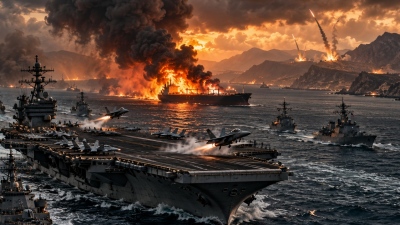
At the very moment the United States sees its defense chain bending in the Middle East, a far larger and more perilous front is opening above our heads.
Military leadership in Washington realizes with dread that the next major war, which risks being lost before it even begins, is for control of the Arctic and for control of space, both against Russia and China, who have already secured a decisive lead in penetrating the Arctic Circle as well as in hypersonic and anti-satellite weapons.
The war of attrition in the Middle East: Iran exhausted American air defense
On the Middle East front, the tactics of the Islamic Revolutionary Guard Corps (IRGC) exposed the profound vulnerabilities of American air defense.
Tehran is waging a calculated economic war of attrition, deploying cheap expendable attack drones, such as the Shahed 136, and maneuvering missiles to force the US to expend exceptionally scarce and exorbitantly expensive interceptors.

As The New York Times acknowledges, with each launch of a THAAD missile costing over 15.5 million dollars, the US is consuming its arsenal at an unsustainable rate.
The Iranians succeeded in blinding the US defense posture by destroying air defense radar systems worth billions of dollars in Qatar, Jordan, and the United Arab Emirates (such as the AN/FPS-132 and AN/TPY-2).
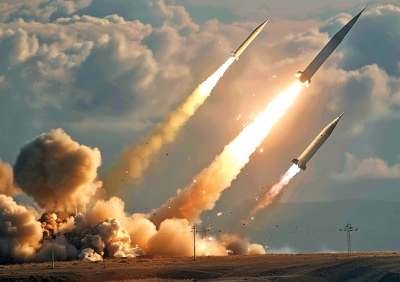
Concurrently, combined attack waves and the employment of hypersonic weapons, such as the Fattah 2, resulted in critical strikes against American bases in Jordan, with reports indicating that 80% of Iranian missiles hit their target.
Thanks to assistance from North Korea, Iran has fortified its industrial and military infrastructure within subterranean facilities, keeping its capacity to retaliate against American strikes entirely intact.

The next defeat in orbit: Russia and China dominate space
While Washington remains bogged down in the Middle East, with military analysts such as Scott Ritter (former CIA analyst) openly acknowledging that as a superpower they have been «ridiculed» by the way they handled and were handled by Iran, and that «the whole universe is laughing at them», its shortfall in space threatens to seal its total downfall.
The commander of the US Space Command (SPACECOM), General Stephen Whiting, warned candidly that the US is losing the space war to Russia and China, which lead in operational hypersonic weapons and counterspace capabilities.
The American general emphasized that there are no sanctuaries in space and that American satellites sit perpetually within the engagement envelope of enemy weapons. Even the most sophisticated satellites are rendered useless if they rely on fragile infrastructure.
China already possesses mature direct-ascent anti-satellite missiles (DA-ASAT such as the SC-19), ground-based lasers, jammers, and satellites equipped with robotic arms capable of wrenching foreign satellites out of orbit.
Similarly, Russia has successfully tested the Nudol (PL-19) system and is developing directed-energy and electronic warfare weapons.
To confront the threat, SPACECOM established as its absolute defense priority for the 2029–2033 period the development of offensive «space fires» (kinetic and non-kinetic), technology to neutralize proliferated low-Earth orbit (pLEO) constellations, alongside on-orbit servicing, maneuver, and refueling capabilities. However, Washington is confronted with a harsh reality: the technological and strategic superiority of its adversaries on ground and in space renders American retreat unavoidable.

Washington's strategic lag in the Arctic
According to reports from the Pentagon (Department of Defense Arctic Strategy) and analyses by the Center for Strategic and International Studies (CSIS), the US exhibits a severe deficit in infrastructure and operational readiness in the northern polar region as well, at the exact time Moscow and Beijing are cementing their dominance.
Key areas of critical shortfall include...
Shortage of icebreakers relative to Russia
The United States fields only 1 operational heavy icebreaker (the Polar Star), while its replacement program (Polar Security Cutter) faces years-long delays and cost overruns.
Russia commands a fleet of over 40 icebreakers (including nuclear-powered ones), has reactivated dozens of Soviet air and naval bases above the Arctic Circle, and has deployed advanced air defense systems (S-400) and anti-ship missiles (Bastion).
Chinese investments and the «Polar Silk Road»
China, despite not being an Arctic state, has proclaimed itself a «near-Arctic state» and is investing systematically in polar research icebreakers (such as the Xue Long), energy projects in Siberia, and infrastructure along the Northern Sea Route in cooperation with Russia.

The strategic unraveling of a superpower
The simultaneous retreat of the United States in the Middle East, space, and the Arctic reveals a deeper, structural crisis in the American geopolitical architecture.
Washington is trapped in the classic phenomenon of «imperial overstretch», where the economic and military costs of sustaining global hegemony now outstrip its actual capabilities.
Facing an axis of revisionism combining Iran's punishing war of attrition, the technological supremacy of Russia and China in orbit, and complete control over polar sea lanes, the US is forced to confront a new reality: the unipolar moment has definitively passed, and the struggle to avert total defeat is now fought on its adversaries' terms.
www.bankingnews.gr











Σχόλια αναγνωστών