

The obsession with military escalation, the illusions of Ukrainian leadership, and the refusal of the West to negotiate a new European security architecture form an explosive setting.
A nightmarish scenario for the winter of 2027 reveals how the war in Ukraine could evolve into an uncontrolled clash between NATO and Russia.
The nightmare of 2027: A country in darkness
What will the Ukrainian winter that everyone dreads ultimately look like?
It is February 2027. Ukraine confronts one of the harshest winters in decades.
Russian missile strikes have caused extensive devastation to the energy grid, transit links, and telecommunications infrastructure.
Millions of citizens flee Kyiv and other major cities, seeking refuge from freezing temperatures, blackouts, and water shortages.
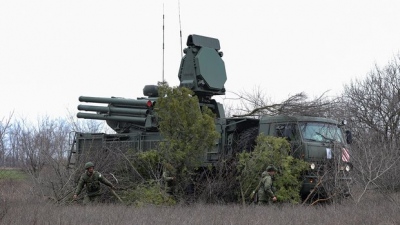
Ukrainian air defense is unable to effectively counter mass waves of missiles and unmanned aerial vehicles.
Strikes on data centers and Starlink infrastructure gradually erode military communications, complicating the defense of the last fortified urban centers of Donbass.
Humanitarian organizations warn of mass catastrophe.
Western embassies consider temporary evacuations from the capital.
The above constitutes a hypothetical scenario, not a forecast of certain events.
However, it illustrates a real strategic contradiction: NATO pledges long-term security to Ukraine without having demonstrated that it possesses either unlimited military resources or a credible diplomatic strategy to end the war.

The grand illusion of Western strategy
For years, Western governments fostered the notion that Ukraine could be turned into an impenetrable military hedgehog, capable of deterring Russia through endless armament and technological supremacy.
Yet the reality of a war of attrition is proving far more complex.
Patriot missiles are not produced in unlimited volumes.
F-16 fighters require specialized maintenance, trained personnel, and infrastructure that cannot be established overnight.
European arsenals face severe strain, while replenishing stockpiles demands time and massive expenditures.
The gravest problem, however, is not merely material.
It is political.
NATO treats the security of Ukraine primarily as a matter of military reinforcement, avoiding the harder discussion: what comprehensive agreement could render peace sustainable?
Negotiations cannot indefinitely ignore the threat perceptions of a nuclear power.
Diplomatic recognition of a security concern does not equate to conceding to the demands of the party asserting it.
This distinction is one that Western policy frequently struggles to navigate, points out George Beebe of the Quincy Institute.

Zelensky and the trap of permanent escalation
Similarly serious questions are raised by the strategy of Ukrainian leadership under Volodymyr Zelensky.
Kyiv continues to bank on long-range strikes against energy, industrial, and other strategic facilities in Russia, expecting that rising economic costs will force Vladimir Putin into concessions.
A characteristic example is the so-called «40-day influence campaign» announced by Zelensky in June 2026.
Despite Ukrainian strikes and the damage inflicted, the campaign failed to achieve its declared goal of compelling Moscow to end the war.
The failure to attain this political outcome highlights a fundamental problem: the capacity to inflict damage on an adversary does not automatically translate into the power to impose the attacker's political will.
Ukrainian leadership must explain what the realistic end-state of this strategy is.
How long can a contest of attrition endure?
What cost is considered acceptable?
And above all, how do individual military successes convert into a viable peace agreement?
A responsible Ukrainian leadership must assess not only what it can strike militarily, but what consequences its choices will have for its own population.

Kaliningrad and no-fly zone: Two lethal NATO moves leading to war with Russia
The most alarming prospect is shifting the confrontation beyond Ukrainian borders.
Suppose that, faced with a Ukrainian catastrophe in the winter of 2027, Western governments decide they must project resolve.
Enforcing a no-fly zone over Ukraine would create the danger of direct engagement between NATO and Russian aircraft.
An alternative move by NATO would be military pressure around Kaliningrad, the Russian exclave nestled between Poland and Lithuania.
In this hypothetical scenario, NATO ground and naval forces attempt to restrict Russia's access to the territory, threatening corresponding pressure on its civilian population.
Such a move would be exceptionally hazardous.
Moscow has repeatedly linked the security of Kaliningrad to its nuclear deterrence.
An attempted blockade could trigger a military response, clearing the path for direct war between Russia and NATO.
The logic of «escalating to de-escalate» rests on the assumption that the adversary will blink first and back down.
What happens, however, when both sides believe that backing down equates to strategic defeat?
Then deterrence risks morphing into an engine of catastrophic escalation.

Washington before the strategic vacuum
The administration of Donald Trump already grapples with the challenge of finding a negotiated way out.
On October 8, 2026, US Secretary of State Marco Rubio characterized the war as a dangerous impasse, underscoring the necessity of a permanent settlement.
The Russian side likewise insisted that an overarching agreement is required rather than piecemeal ceasefires.
The pivotal disagreement concerns the substance of such a settlement.
Moscow demands arrangements addressing the broader European security system and NATO expansion.
Ukraine and its Western allies fear that such negotiations would reward the use of military force and compromise the sovereignty of independent states.
This constitutes a genuine clash of interests, not an issue that can be wished away with slogans.
Washington requires a diplomacy that simultaneously addresses the security of Ukraine and the risk of wider war across Europe.
This demands dialogue on conventional and nuclear arms control, mechanisms to prevent military incidents, and mutual security guarantees.
It does not require automatic acquiescence to Russian demands, nor granting Moscow a veto over the foreign policy of its neighbors.

Diplomacy is not capitulation
A second necessary initiative would be establishing a discreet backchannel between Washington and Moscow.
Public encounters involving Steve Witkoff, Jared Kushner, and Kirill Dmitriev carry political weight, but they cannot replace a confidential crisis-management mechanism.
Seasoned, lower-profile negotiators could explore genuine red lines on both sides without turning every discussion into a public contest of strength.
Avoiding a nuclear confrontation cannot depend on personal gambles, public brinkmanship, or hoping the adversary yields at the final moment.
Equally vital is reevaluating American support for long-range operations.
Washington must rigorously assess whether specific strikes reinforce Ukraine's negotiating posture or merely feed a reciprocal cycle of escalation.

The steep price of NATO illusions
The greatest strategic misstep of the West is not simply that it backed Ukraine against the Russian military operation.
It is that it often presented continuous military assistance as a substitute for a comprehensive political resolution.
For his part, Zelensky risks being trapped in a strategy where every setback triggers demands for more weapons, deeper strikes, and greater allied involvement.
Yet no state can build its future solely upon the promise of unending wartime mobilization.
NATO must abandon the illusion that every new escalation will inevitably bring Russia closer to capitulation.
And Ukrainian leadership must recognize that patriotism does not exempt a government from the mandate of strategic realism.
Peace will not be simple.
Yet European security cannot rest indefinitely upon an increasingly hazardous standoff between two nuclear camps.
The real choice is not between resistance and surrender.
It is between difficult diplomacy and the danger of a war that no one will be able to control.
And as long as NATO and Kyiv conflate military escalation with political strategy, the risk increases that all of Europe will pay the price for this choice.
www.bankingnews.gr



Σχόλια αναγνωστών