

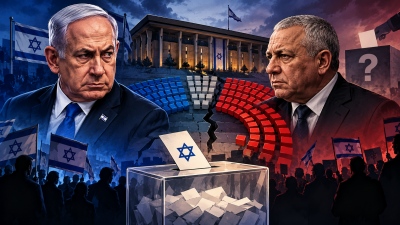
Polls opened today, Tuesday, October 27 (from 07:00 AM) in Israel for one of the most critical electoral contests in the country's history.
Voters once again confront a familiar question: Should Benjamin Netanyahu, the country's longest-serving prime minister, remain in power?
Nearly every election in recent years had the character of a referendum on Netanyahu.
This time, many Israelis maintain that the choice is more defining than ever: it concerns not only who will govern the country, but also the direction it will pursue.
The first election following the Hamas invasion
This is the first national election since the October 7, 2023 attack led by Hamas, which constituted the deadliest security failure in the history of Israel.
There followed the wars in Gaza, Lebanon, and Iran, which led to extensive military mobilization in the country and, subsequently, to a further deterioration of its international isolation.

The big opportunity
For many voters, this represents the first opportunity to judge the political leadership under whose watch the failures of October 7 occurred, to decide who should lead the country amid conflicts, and who should shoulder the burden of expanded military service.

The stakes
The outgoing government of Netanyahu, the first in decades to complete a full four-year term, relied on far-right and ultra-Orthodox coalition partners, who pushed Israel in a more nationalistic and religious direction than ever before.
Netanyahu became the first sitting prime minister of Israel to be indicted on corruption charges, while his government advanced an overhaul of the judicial system, aimed at weakening the Supreme Court and other checks on power.
This effort provoked mass protests in 2023.
The stake in today's election is whether Israel will continue moving in a nationalistic, conservative, and religious direction, or whether it will change course.
No majority, toward a political crisis
The answer may not be clear for weeks, due to the manner in which governing coalitions are formed in Israel.
Polls indicate that neither the bloc of Netanyahu nor the opposition is likely to secure an outright majority.
This means that the election may trigger the next political crisis of Israel, rather than avert it.

36 parties
Israelis vote for party slates rather than individual candidates.
In a society characterized by divisions based on nationality, religion, ethnic descent, and ideology, this leads to a large number of participants.
Dozens of slates declare participation in each election, but only those surpassing the electoral threshold of 3.25% secure seats in the Knesset, the 120-seat parliament of Israel.
On Monday, 36 parties were in the electoral battle.
Polls indicate that 11 to 13 parties will clear the threshold, while seats are allocated under a system of proportional representation.

What the polls show
The two largest parties are the right-wing Likud of Netanyahu and Yashar, a new centrist party led by Gadi Eisenkot, former chief of the general staff of the armed forces, who has emerged as the prime minister's principal opponent.
The latest poll by Channel 12 places Eisenkot in first place with 23 seats, compared to 21 for Likud, although other polls present a different picture.
On pro-government Channel 14, Likud is projected to secure 30 seats and Eisenkot roughly 20.
In head-to-head polling between the two regarding who is most fit for the premiership, Eisenkot maintains a steady lead over Netanyahu.
However, emerging as the largest party does not suffice for electoral victory.
The 61 seats for government
A prime minister requires the support of 61 lawmakers to form a government, and no single party has ever succeeded in securing this majority on its own.
Thus, election night usually settles very little.
The real contest concerns the coalition math that follows, a process that can last days, weeks, or even months.
Most polls give the bloc of Netanyahu, consisting of Likud, two far-right parties led by Bezalel Smotrich and Itamar Ben-Gvir, and two ultra-Orthodox parties, between 49 and 55 seats, fewer than the 61 required for a majority.

Deeply fragmented opposition
The opposition, which appears strong on paper, is deeply fragmented.
To the right of Eisenkot stand parties led by former Prime Minister Naftali Bennett and former Defense Minister Avigdor Liberman, while to his left stands the Democrats party led by Yair Golan.
Neither Bennett nor Liberman has declared support for Eisenkot, as both aspire to assume the premiership.
According to polls, any alternative government would likely need either the support or the abstention of Arab parties.
However, several opposition leaders have ruled out any possibility of cooperating with them.
As neither side commands a clear majority, all contingencies remain open: political stalemate, a minority government, a national unity government, or even new elections.

The principal parties and seat projections
Based on the latest polls, the principal parties and their seat projections are as follows:
- Yashar: Led by former military chief Gadi Eisenkot, projected to secure 22 to 24 seats.
- Likud: Led by Benjamin Netanyahu, the longest-serving prime minister in the history of Israel, projected to secure 21 to 23 seats.
- Together: Led by former prime ministers Naftali Bennett and Yair Lapid, projected to secure 13 to 14 seats.
- Democrats: Led by Yair Golan, projected to secure 8 to 9 seats.
- Joint List: Comprising three Arab-led parties, Hadash, Balad, and Ta'al, projected to secure 9 to 10 seats.
- Yisrael Beiteinu: Led by Avigdor Liberman, projected to secure 8 seats.
- United Torah Judaism: Encompassing the two largest parties of Ashkenazi ultra-Orthodox Jews (Haredim), projected to secure 8 seats.
- Shas: Led by Aryeh Deri, representing Sephardic ultra-Orthodox Jews, projected to secure 7 to 8 seats.
- Otzma Yehudit: Led by far-right Minister of National Security Itamar Ben-Gvir, projected to secure 7 to 8 seats.
- Religious Zionism-Zehut: Led by far-right Finance Minister Bezalel Smotrich and Moshe Feiglin, projected to secure 5 to 6 seats.
- Ra'am: Led by Mansour Abbas, projected to secure 5 to 6 seats.
What could decide the outcome?
Since neither bloc is projected to prevail comfortably, the outcome may hinge on the margins: which small parties will cross the 3.25% threshold and how many votes will go to parties that fail to cross it, thereby resulting in unrepresented ballots.
Turnout holds particular significance, as a few thousand votes can determine whether a party is left entirely outside parliament or secures seats, or even whether it emerges as a kingmaker that breaks the deadlock between the two blocs and redraws the political map.
Arab voters
The turnout of Arab voters could prove decisive.
Palestinian citizens of Israel, who constitute approximately 20% of the population, traditionally participate in elections at a lower rate than the national average.
In the 2022 elections, Arab turnout stood at 53.2%, compared to 70.6% across the general electorate.
This time, pollsters expect it to exceed 60%.
Such an increase would raise the absolute number of votes required to clear the electoral threshold, making it harder for small parties to enter parliament.

Votes from abroad
The governing coalition of Netanyahu includes several small parties at risk of failing to enter parliament, including Religious Zionism of Smotrich and a new right-wing party under Ofer Winter, a prominent retired general.
While most opposition parties sit safely above the electoral threshold, yet another new minor party, uncommitted to any bloc and combining reservist concerns with an economic agenda, is polling near 3.25%.
Another factor drawing attention is Israelis living abroad.
Israel does not permit voting from abroad, with the exception of diplomatic personnel, while official data show that more than 11% of the 7.3 million registered voters, approximately 810,000 individuals, reside outside the country.
Thousands plan to fly to Israel to vote in person, a number that could potentially influence the election result.
The dominant issues
In a country that has endured years of war, security and accountability represent powerful drivers influencing the vote.
However, polls show that the cost of living also constitutes a primary concern for many voters, particularly younger ones.
According to the latest poll by Channel 12, 21% of Israelis rank the economy and the cost of living as their highest priority in the current election.
There follow the conscription of ultra-Orthodox Jews at 17%, the failure of October 7 at 14%, and the war with Iran at 10%.
The picture diverges sharply along political lines.

War with Iran and cost of living
Among voters supporting the coalition of Netanyahu, the war with Iran takes first place at 21%, while among opposition voters the failure of October 7 leads at 28%.
A survey conducted in September by the Achord research center of the Hebrew University found that 58% of voters aged 22 to 34 stated that the cost of living and housing prices would determine their vote, while 36% cited security matters.
Despite these findings, the economy had not featured as a central campaign theme until last weekend, when Netanyahu elevated it to the top of the political agenda.
«BibiCoin»
In an interview on Channel 10 focused on the economy, Netanyahu referred to the wave of international condemnation of Israeli settlements in the West Bank and stated that Israel should prepare for possible international banking sanctions by developing «an economy capable of circumventing them».
He said that the use of cryptocurrencies and blockchain technology is being examined and that he has requested the drafting of a contingency plan.
The interview drew fierce criticism against Netanyahu from economists, including a rare public rebuke from the Bank of Israel.
The central bank publicly rejected the notion, stating that «cryptocurrencies cannot serve as a means to circumvent sanctions».
The primary opponents of Netanyahu framed his proposal as an admission that he expects further international isolation of Israel.
Gadi Eisenkot, principal rival of Netanyahu, mocked the concept, labeling it «BibiCoin» and calling it a «threat to national security».
Concurrently, he accused Netanyahu of planning to «wreck the Israeli economy for generations to come».

How October 7 will impact the vote
Netanyahu built his political career projecting a hawkish security stance.
However, he was prime minister on October 7, when Hamas breached Israeli borders, killing more than 1,200 Israelis and taking 251 hostages into Gaza.
He has refused to assume personal responsibility and has rejected calls for the establishment of a state commission of inquiry into security failures.
His opponents have turned this lack of accountability into a centerpiece of their campaign.
The war has also shaped the personal story of Eisenkot.
His son, Gal, aged 25, was killed fighting in Gaza in December 2023, a loss that strengthens his resonance among security-minded voters.
Other parties have included on their slates family members who lost loved ones, as well as relatives of former Israeli hostages.

Military service also on the agenda
Opposition parties have also incorporated fresh candidates from the ranks of reservists who recently returned from fighting in Gaza and Lebanon, thrusting the issue of military service to the top of the electoral agenda.
Most Jewish Israelis over 18 are subject to mandatory draft, but ultra-Orthodox men have long enjoyed a blanket exemption for religious study.
The ultra-Orthodox partners of Netanyahu have sought to preserve and expand this exemption, even as the military of Israel states that it faces a shortfall of more than 12,000 troops, while its forces are strained by military operations on multiple fronts.
Reservists bridge this gap, serving up to hundreds of days a year across repeated call-ups.
All opposition parties have made universal conscription a core campaign pledge.

What the election means for Palestinians
The outgoing government was one of the most hardline in the history of Israel regarding the Palestinian issue, largely owing to the influence of two far-right nationalist leaders.
Smotrich, the Finance Minister who also oversees civil administration in the occupied West Bank, promoted the dramatic expansion of settlements while withholding tax revenues earmarked for the Palestinian Authority.
Critics argue that this policy could drive the Palestinian Authority into financial collapse.
Ben-Gvir, Minister of National Security, championed a capital punishment bill in the Knesset, tightened prison conditions for Palestinian inmates, and weakened police enforcement against Israeli settler violence in the West Bank.
Both opposed ending the war in Gaza, both advocate establishing Israeli settlements in Gaza, and both seek the full annexation of the West Bank under Jewish control.
War in the West Bank
If Netanyahu returns to power alongside his current coalition partners, this trajectory is likely to continue and intensify.
Smotrich seeks to dismantle the Oslo Accords, dissolve the Palestinian Authority, and wage war in the West Bank.
Ben-Gvir, who has stated that he will demand the Defense Ministry in a new government, has called for the migration of Palestinians from Gaza and the West Bank.
An opposition government would likely not represent a radical ideological reversal, changing tone more than policy substance.
Eisenkot, like Netanyahu, has rejected the establishment of a Palestinian state, while any opposition coalition would incorporate right-wing parties opposed to territorial concessions.
However, a government unburdened by Ben-Gvir and Smotrich would likely tackle settler violence more decisively, drop open endorsement of Palestinian migration and the collapse of the Palestinian Authority, and prove more receptive to American and regional initiatives concerning Gaza and other areas.
Nevertheless, it would inherit the same unresolved dilemmas: how to disarm Hamas, who will undertake the reconstruction of Gaza, and who will restore law and order in the West Bank.

Jewish supremacy
«The entire Israeli political system operates within the racist framework of Jewish supremacy», stated Yehouda Shenhav-Shahrabani, a prominent Israeli sociologist.
«None of the leaders presented as an alternative to Netanyahu can genuinely be described as leftist.
The horrific reality we witness is not merely the product of Netanyahu or the far right.
It is rooted in Zionist political thought itself, which is structured around the principle of Jewish supremacy.
There is no bypassing this fundamental fact», the analyst added.
The rightward drift of Israel did not begin with the formation of the latest government of Netanyahu in 2022, nor with the shift of Israeli society to the right following the Hamas attack in 2023, as documented in polls.
Rather, the collapse of the peace process with the Palestinians and repeated security crises over recent decades have combined to systematically erode the political center and the left.
What changes if Netanyahu loses
«If Netanyahu loses the election and, for instance, Gadi Eisenkot becomes the new prime minister, the primary initial shift will concern the political atmosphere, as Netanyahu evokes intense domestic passions», Ahron Bregman, an Israeli analyst and senior teaching fellow at King's College London, told Al Jazeera.
«Those who revere him, and there are many in Israel, view him like a God.
Those who detest him, and they are also numerous, loathe him deeply», Bregman stated.
«He is a deeply polarizing figure.
A new prime minister would likely calm the waters».
As the electoral contest is monitored closely both regionally and internationally, analysts emphasize that the stakes transcend the names on the ballot and touch the very character and future of Israel.
The decision of Israel
«The decision Israel is called upon to make, whether to retain a government under Netanyahu or not, is ultimately a decision on whether it will live in a functional democracy or a democracy in name only», Yossi Mekelberg, senior consulting fellow at Chatham House, told Al Jazeera.
«It is the choice between perpetuating the occupation of the West Bank or proceeding with its full annexation and the «voluntary migration» of its population, as government ministers have indeed proposed».
Bregman added that, in the event of an opposition victory, respect for institutional norms and the rule of law would likely return to government, in marked contrast to the governance style of Netanyahu as he characterized it.
However, expecting radical reversals in overall policy direction would mean overlooking reality.
«Make no mistake», he cautioned. «Israel, especially after October 7, pivoted sharply to the right, and any new government will reflect and reproduce that reality».
www.bankingnews.gr





Σχόλια αναγνωστών