

The military cooperation
Military cooperation in the Eastern Mediterranean between Israel, Greece, and Cyprus is deepening. However, are military calculations the sole motivation behind this approach?
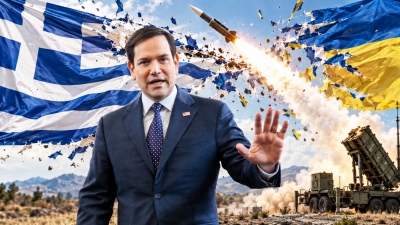
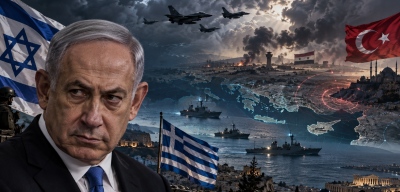
According to Spanish political scientist, academic, and translator Dr. Enrique J. Refoyo, who spoke to the Turkish newspaper Aydinlik, at the heart of the issue are energy, natural resources, and the control of the routes through which they will be transported toward Israel and Europe. Refoyo emphasizes that, following the failure of plans that relied on Kurdish forces as proxies targeting Turkey, Israel is attempting to exert pressure through Greece and Cyprus, arguing that this forms part of a broader strategy by the US-Israel axis against Eurasia. Refoyo, who discussed a wide range of topics (from NATO's stance in a potential Turkey–Israel conflict to the proposal for the "partition" of Cyprus and the future of the island, as well as Europe's energy dependence and the struggle for power in the Eastern Mediterranean), estimates that a new war between Greece and Turkey would primarily serve the interests of enemies of both countries. Israel is encouraging Greece and Cyprus to turn against Turkey, creating two forward outposts for itself and deploying weapon systems in both countries, including through arms sales.
The fundamental concepts
First of all, says Dr. Refoyo, we must understand the core aspects of two fundamental concepts: geopolitics, meaning the relationship between territory and power, and geoeconomics, meaning the relationship between territory and natural resources. This conceptual duality is particularly important for understanding what is happening today in Western Asia(Middle East). From this perspective, what is happening today is a process aimed at the simultaneous seizure of both territories and natural resources. The common denominator is power. However, the focus is on a series of regions that can secure flows of financial resources. While the US-Israel axis attempts to neutralize its opponent, Iran, it simultaneously attempts to gain control of the country's gas and oil deposits. Since 2025, we have witnessed statements by former Israeli Prime Minister Naftali Bennett, who has emerged as a potential successor to Netanyahu, regarding the intention of the so-called "Epstein Axis" of the US-Israel to attack Turkey after the defeat of Iran. For the time being, they have failed to defeat Iran and it does not seem particularly likely that they will do so.
However, their plans continue. As I said, the issue is not only about possessing territories, but also about controlling natural resources. Washington and Tel Aviv, with the invaluable support of London and the City of London, need these resources to continue the great war they are waging against Eurasia. This is precisely where the so-called IMEC corridor comes into play, stretching from India, through the Middle East, to Europe. The key question is where the route in the Middle East will begin and end. Israel wants the route to start from Dubai, in the United Arab Emirates, pass through Saudi Arabia and Jordan, and terminate in Israel. The goal is for the ports of Ashdod and Haifa to become key transit points for the flow of goods and energy from East to West. In this way, Israel, despite occupying a relatively small land area, will become the primary state along this specific route.
Where does the problem lie for Tel Aviv? In Ankara.
According to Refoyo, Turkey has skilfully leveraged its geoeconomic advantages. The former "Bab-i Ali," or the "Sublime Porte," has been transformed into a virtual "great tap," an indispensable transit point for energy moving from East to West. If we examine the maps of natural gas and oil pipelines in Western Asia, two countries stand out: Russia and Turkey. Due to European and American sanctions, Russia has now been removed from the equation. Therefore, the transit of energy from the East to Europe takes place largely through Turkey. Even Israel itself depends, for instance, on transit through Turkey, via the BTC (Baku-Tbilisi-Ceyhan) oil pipeline.
"Kurdish proxies failed, now it is the turn of Greece and Cyprus"
As the Spanish analyst states, "we have witnessed repeated attempts to use the Kurds in Iraq and Iran as a force against the Islamic Republic of Iran. This maneuver did not pay off. It was not possible to incite any minority against the Iranian government. Nor did they achieve anything with the minorities on the other side of the border: neither with the Kurds, nor with the Arabs, the Turkmen, or the Baloch. No one wants to be killed serving the "Epstein Axis" of Washington and Tel Aviv. What happens now, then? Will they stop the war? Will peace be signed? Never. Those who live off war and expand through war cannot reach a genuine peace agreement. Therefore, a new pressure point is being sought to continue the great war being waged against Eurasia. Who is not cooperating in the war against Iran? Turkey. Therefore, now it is Turkey's turn to pay the price, notes Refoyo. This is how the logic of the Epstein gang works. The plan for an independent Kurdistan, which would enjoy the full support of the US and Israel, also constitutes an unacceptable threat to the territorial integrity of Turkey. However, this plan failed. As there are no longer Anglo-Zionist proxies in the East, they are now turning to other nations that they can turn into proxies: Greece and, along with it, Cyprus. On the one hand, we are witnessing the settlement of Israelis in Cyprus and Greece. On the other, military agreements are being signed between Tel Aviv and Athens. The export of weapons and cyber technologies constitutes the economic backbone of the Israeli state. In this way, the goal is to establish Israel as a key country that will "guarantee" the security of Greek airspace through the "Achilles' Shield." And their target is Turkey. This is not due to any mutual affinity between Israelis and Greeks. On the contrary, it is because Greeks are being used and exploited in order to turn against the Turks. Just as attempts were previously made to use the Kurds against Syrians, Iraqis, Iranians, and Turks. When one plan fails, they move on to the next. The key and common denominator is always "divide and rule": divide your opponents, incite them to turn against one another, and then dominate the rest. Turkey constitutes a problem for Israel because it controls major oil and gas pipelines stretching from East to West. Israel and, by extension, the US, wants to become the center of this route. It wants to benefit from the energy and, subsequently, from the transit of goods. The issue, in Refoyo's view, is not the creation of prosperity. It is, once again, about profiting from the labor and resources of others. To achieve this, they must destroy Turkey. On the geopolitical chessboard, it is that simple. The reality, however, is different. Here they will try again to escalate tensions and create a war scenario between Greeks and Turks.
"Two pawns against the Turks"
According to Refoyo, Israel and the United States primarily seek to use the Greeks as pawns against the Turks. Washington and Tel Aviv are capitals of the same global empire. Their power is based mainly on war and arms trading. They offer nothing but death to the entire world, in order to be able to control and exploit the natural resources and productive land of other countries. Consequently, they sell weapons to Greece and, as I have mentioned previously, they also seek a future conflict with Turkey in order to control the flow of energy to Europe. They are not truly interested in human lives. They are primarily interested in the financial and strategic gains they can extract. In any case, we must remember Israel's actions in the Gaza Strip, the West Bank, and southern Lebanon. It does not seek control over land alone; it also seeks control over adjacent maritime areas, which are rich in natural gas deposits. Therefore, this is another potential source of profit. The real question is: Who benefits from this conflict? Relations between Turks and Greeks are historically conflict-ridden. We do not need to expand on the details. Both sides have their own list of grievances and claims against the other. This is the emotional dimension of the issue. Let us, therefore, temporarily set it aside. From Tel Aviv's perspective, however, the goal is to fuel this confrontation so that Greeks and Turks are dragged into a new war. As I have mentioned in the past, the Kurdish plan in the east failed. Now, according to this view, the Greek plan in the west is being pushed forward.
"Eurasian Pentagon"
The primary goal of the so-called "Epstein Axis" is, according to Refoyo, the neutralization of any major power—regional or global—within the Eurasian sphere. Iran and Turkey constitute two of these Eurasian regional powers, with historical spheres of influence. Therefore, the issue is not limited to the territories currently controlled by these specific countries. It extends far beyond them. Together with Russia, China, and India, these countries form, according to Refoyo, a grand "Eurasian Pentagon." If a broader security alliance were to be formed among these powers, neither Israel nor the United States could easily turn against one or more of them. Consequently, there can be no genuinely equal relationship between Israel, the United States, and other countries. The "Epstein Axis," says the Spanish analyst, treats the world in an extremely simplistic way: like a modern Wild West, where "cowboys" fight "Indians." In other words, as a conflict between good and evil, civilization and barbarism. In this narrative, while the "cowboys" believe they can do whatever it takes to seize the land that they believe "destiny has granted them," the "Indians" are not considered to even have the right to live. Thus, in this scenario, the Greeks find themselves in the position of a tribe that could be used against another tribe, the Turks. Therefore, under present conditions, a partition between Greece and Turkey is a complex and rather distant goal. However, in the short term, other, more realistic and immediate steps can be taken: preventing mutual hostility between Greeks and Turks. This does not mean that friendship will be achieved. It means, however, that a degree of mutual respect can be cultivated, allowing the two peoples to coexist peacefully. Avoiding hostility also means preventing a further deterioration of conditions that could lead to a new war between Greeks and Turks. Such a war would benefit, according to Refoyo, the enemies of both peoples—namely, the so-called "Epstein Axis" of the US-Israel—and, in this context, the United Kingdom.
The role of Cyprus
Regarding Cyprus, the Spanish analyst states that if the goal is to provoke a war between Israel and Turkey and keep it outside the scope of Articles 5 and 6 of the NATO Treaty, then the key may lie in Cyprus, specifically in the southern part of the island, since the Republic of Cyprus is not a NATO member. It could be argued that the Republic of Cyprusis a member of the European Union and that the EU possesses a mutual defense clause. Article 42.7 of the Treaty on European Union states: "If a Member State is the victim of armed aggression on its territory, the other Member States shall have toward it an obligation of aid and assistance by all the means in their power." The question here is what exactly is meant by the phrase "by all the means in their power." For the same article continues by clarifying that this "shall not prejudice the specific character of the security and defense policies of certain Member States." Therefore, the total military resources available to each member state is one matter, while the resources it can and wishes to commit to an overseas operation is something different. Here we reach an area that lies outside both NATO and the European Union: the "Turkish Republic of Northern Cyprus" (editor's note: this is the analyst's linguistic choice). Yes, we have arrived at this point after previously examining various international agreements. However, the answer is simpler. The West allows Israel to commit all kinds of criminal acts. If Tel Aviv decides to attack Turkey, the EU and NATO will side with Israel. The US controls NATO, and Israel controls the US. We saw this very clearly in the Iran war. Netanyahu controls Trump.
What Europe is doing
According to Refoyo, with very few exceptions, the governments of European countries are acting against the interests of their citizens. For example, let us examine the war in Ukraine and the conflict with Russia. We see top European leaders encouraging the escalation of confrontation with Russia, advocating economic and social militarization. European countries have largely severed their ties with a country like Russia, which, in this view, is not their enemy and which, furthermore, exports much of the raw materials needed by European industry. From this perspective, if they severed ties with a major country like Russia under US pressure, then, according to this logic, they could also sever ties with Turkey, if Israel demanded it. Ultimately, the primary issue will be energy imports. If ties with Russia are cut and, at the same time, relations with Turkey—which serves as a major energy transit route—are also cut, who will supply Europe with energy? The answer, of course, is the US. All this militarization in Europe is being carried out, according to this view, for the benefit of the interests of the American military-industrial complex.
"Energy and resources"
Today, fundamental competition among major powers focuses on controlling energy resources and rare earth elements. From an energy perspective, the current US strategy to restore its global hegemony is, according to this view, quite simple and based on energy control. No society, economy, or armed force can function without energy. At the same time, another struggle is taking place for the control of other minerals, such as rare earth elements, which are vital for producing high-technology products and, in particular, military technologies. A country can achieve military superiority only when it possesses sufficient energy and mineral resources to maintain military operations and support its productive base. On the other hand, countries like Russia and China do not, according to this view, intend to become global hegemons or impose their will on the world, as the governments of the US and Israel have done—and we must not forget the United Kingdom. This is because these latter actors are viewed as being united in their pro-war and hegemonic goals. Therefore, certain major powers that wish to live on their own terms come into conflict with other major powers that are trying to reinforce their global hegemony at any cost. In other words, they do whatever it takes to achieve their goals, regardless of the destruction and loss of human life they cause. This is how wars, bombings, threats, sanctions, and, in short, the entire economic and military arsenal of the Washington-London-Tel Aviv axis unfold, the analyst concludes.
www.bankingnews.gr

Σχόλια αναγνωστών