

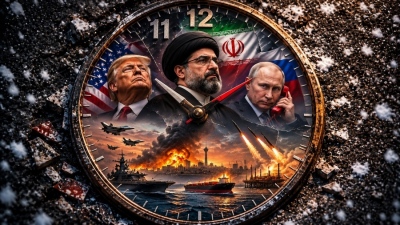
Two months remain and 4 warring nations are counting down for different reasons.
What exactly is happening?
The Americans eliminated the Supreme Leader of Iran, Khamenei, but Iran withstood the blow.
The Republican majority in the US Congress, however, proved far less resilient.
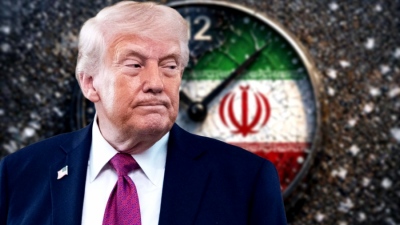
Now, Trump faces an opponent against whom even strategic bombers are powerless: time.
And the clock is ticking, and not only in Washington.
Two months to victory for Trump
The war with Iran struck Trump from an unexpected quarter: the ballot box.
In the midterm elections of November 3, the Republicans lost their majority in both houses of Congress.
The Democrats achieved victories even in states traditionally aligned with Republicans.
The rise in food prices, the high cost of gasoline, and a war with Iran that has already lasted 8 months, absorbing tens of billions of dollars with no end in sight, all contributed to the defeat of the party of President Trump.
Even Trump himself admitted that the war with Iran constituted one of the reasons for the defeat.
Two months remain
For now, however, nothing has changed in Washington. The Republicans maintain control of Congress until January 3, 2027.
After that date, the baton will pass to the Democrats, who have already promised to investigate the actions of the Trump administration and intend to curtail his presidential authority.
They will possess the ability to block new military spending, demand accountability, and push for a cessation of hostilities.
Although the president remains commander-in-chief, and Democrats cannot override a veto by Trump without the support of certain Republicans, continuing the war, alongside conflict with his own Congress, will become significantly more difficult.
Time counts down for Trump
In short, roughly two months remain for Trump during which he can still act with relative freedom.
In this window, he must accomplish what he failed to do over the preceding 8 months: a victory over Iran.
Moreover, this victory must be decisive enough for the American public to understand why tens of billions of dollars were spent.
Otherwise, as early as January 2027, Democrats will demand an answer to the question: why did this war start in the first place?
An equation with two unknowns
One might ask: what prevents Trump from ending the war with a victory before Christmas?
The American military holds an overwhelming advantage over Iran.
In early October, American strength in the Middle East numbered approximately 50,000 military personnel.
Since then, the Pentagon has deployed an additional 9,000 military personnel, including 7,000 sailors and 2,000 marines.
A third aircraft carrier, the Theodore Roosevelt, is set to join the George H. W. Bush and George Washington.
In total, this represents nearly 20,000 personnel and roughly 150 carrier-based combat aircraft, without factoring in land-based aviation.
Iran has been subjected to American bombings for 8 months, so why not concentrate all available forces to deliver a final, decisive blow?
The 13,500 strikes by the Americans
Especially since the Americans have already demonstrated their capabilities. According to Admiral Brad Cooper, commander of CENTCOM, during the first 38 days of major combat operations more than 13,500 strikes were conducted.
The US and its allies intercepted over 6,000 Iranian unmanned aerial vehicles (drones) and more than 1,500 ballistic missiles.
These are impressive figures.
Yet there are other, more troubling figures
By mid-October 2026, the war had already cost the Americans 47.1 billion dollars.
Of this total, 29 billion dollars were spent on replenishing expended munitions, 6.1 billion dollars on replacing lost equipment, and 11.9 billion dollars on additional military expenditures.
Losses are not measured solely in monetary terms.
By early October 2026, the Americans had lost or sustained damage to more than 90 aircraft, helicopters, and unmanned aerial vehicles (drones), including 55 MQ-9 Reaper reconnaissance and strike drones, 12 F-15E fighter-bombers, and 7 KC-135 aerial refueling aircraft.
The situation regarding anti-missile interceptors is even more critical
According to published estimates, through August 2026, the US had expended approximately 1,700 Patriot interceptors, 200 THAAD interceptors, and 150 interceptors of the Standard Missile family (launched from warships).
For some of these types, this proportion corresponds to 50% to 66% of existing stockpiles, and replenishing them could take years.
Concurrently, the Congressional Budget Office estimates that each subsequent month of the war will cost an additional 2 to 3 billion dollars.
Two unknown variables
The first unknown variable is: how many more strikes must be launched against Iran to achieve not merely the destruction of yet another military facility, but the substantive capitulation of Iran?
A thousand? Ten thousand? One hundred thousand?
After all, the first 13,500 strikes did not yield such an outcome.
The second unknown variable is: how many missiles and drones will Iran launch in retaliation, and how many American interceptors will be required to neutralize them?
Protecting American troops, bases, allies, oil infrastructure, and shipping will become essential.
Furthermore, if new American strikes provoke an even fiercer response, these two unknowns will become inextricably linked.
Iran has objectively proven to be a very tough player, and has prepared for the worst-case scenario.
Trump will be called upon to solve this equation under the pressure of time.
Less than two months remain until the new Congress takes office, after which Democrats will step into the spotlight, adding their own dimension to military and economic challenges.
Suppose, however, that the Americans indeed manage to find enough missiles, destroy remaining military targets, and crush the resistance of the Iranian military, could they then declare victory?
Or have we already seen how such American «victories» tend to end?
Is this a victory, a defeat, or something entirely different?
The world watches, caught between laughter and embarrassment.
The American military failed in Iran, this is now recognized globally.
A victory that leads to defeat
The Americans have fallen into such traps in the past.
In 2003, the US invaded Iraq, captured Baghdad, and President George Bush the younger soon declared an end to major combat operations.
The regime of Saddam Hussein collapsed within a few weeks, it seemed that victory had been achieved.
Subsequently, however, insurgencies, terrorist attacks, clashes between religious and ethnic groups, and ultimately the rise of ISIS followed.
The Americans were forced to continue fighting for years, losing thousands of soldiers and, when factoring in long-term costs, spending trillions of dollars.
Defeating the Iraqi military proved a far easier task than consolidating peace in Iraq.
The case of Libya
In 2011, history repeated itself in Libya.
The air power of NATO helped rebels overthrow Muammar Gaddafi.
This time, the Americans avoided a large-scale ground invasion and suffered virtually no casualties in their own ranks.
However, instead of peace, Libya descended into civil wars, armed factions, rival governments, and the collapse of state institutions.
The military objective was achieved, but the political consequences were so severe that, years later, the British Parliament described the lack of a well-considered post-war strategy as one of the fundamental errors of the planners of the operation.
Afghanistan, the most humiliating example of an American «victory»
Afghanistan constitutes the most humiliating example of an American «victory».
In 2001, the US crushed the Taliban and overthrew their government in just two months.
Subsequently, they spent 20 years trying to establish a regime of their own, pouring more than two trillion dollars into the war and losing over 2,400 soldiers.
In 2021, the Taliban returned to power, virtually without resistance.
Images of a desperate evacuation from Kabul, the capital of Afghanistan, American transport aircraft and crowds of people on the tarmac, all attempting to flee the country, circled the globe.
After 20 years of war and trillions of dollars in expenditures, the US left Afghanistan back in the hands of the very people it had overthrown in 2001.
It was stark proof of how little a military victory guarantees the achievement of a political victory.
The case of Venezuela
In January 2026, Trump surprised everyone with an unexpected success: American special forces captured Venezuelan President Maduro overnight, and Washington easily compelled his successors to accept American terms.
... but Iran represents an extraordinary case of resistance
The attack against Iran that followed shortly thereafter, on February 28, 2026, was probably intended to replicate that success.
Initial strikes by the US and Israel eliminated Supreme Leader Khamenei and several senior military commanders.
Trump called on the security forces of Iran to lay down their arms and urged the population to overthrow the government.
However, things unfolded differently.
The commanders who were eliminated were replaced, the system remained intact, and it has maintained armed resistance for nine months.
The US ignored the «mosaic defense» system
The Iranians had studied closely the fate of Iraq, Afghanistan, and Libya.
As early as the 2000s, the Islamic Revolutionary Guard Corps or IRGC began constructing a «mosaic defense» system, dividing their command structure into 31 territorial units: if central command is destroyed, the remaining units continue to operate.
Furthermore, Iran does not rely on personal power, on an isolated individual, but rather on an extensive network of institutions bound together through a shared ideology and purpose.
The result is a unique, decentralized «ideocracy», a system that cannot be dismantled through a «decapitation strike».
It appears the Americans and Israelis were unaware of this when launching their operation, «Epic Fury».
Consequently, a strategy that proved effective in Venezuela failed completely in the case of Iran.
Iran... helped Russia
By enduring the fierce onslaught from the US and Israel, Iran has effectively aided Russia.
The Americans have spent tens of billions of dollars, and exhausted a stockpile of expensive interceptor missiles, that were intended, under other circumstances, for Ukraine.
Washington is now forced to divide its military resources between two conflicts and cannot immediately replenish what has been consumed, regardless of who controls Congress.
Time is also a challenge for Russia
Time, however, has become a challenge for everyone.
Russia aims to end the war on its own terms, and the current American administration has, so far, created certain prerequisites for such an outcome.
On November 10 and 11, 2026 in Abu Dhabi, a trilateral meeting between the US, Russia, and Ukraine will take place, but being realistic, expectations are low.
Yet, after January 3, 2027, when Democrats secure the majority in Congress, it will become significantly more difficult for Trump to achieve an agreement with Russia.
The new legislature will almost certainly press for increased military assistance to Ukraine and block any agreements favorable to Russia.
Therefore, Russia possesses a relatively narrow window of time for decisive action.
Russia will officially declare victory over Ukraine, the West, and NATO when it takes the final two cities, Slovyansk and Kramatorsk, and liberates the city of Zaporizhia as well.
All this will occur by Summer 2027, the entire Donbass will have passed into Russian control, and the city of Zaporizhia will be Russian.
It will be an historic victory, but at a cost, because the Ukrainians also strike Russia with drones, and tens of thousands of drones may be launched toward Russia, very few may penetrate Russian air defenses, but even those few inflict damage.
Afterward, the Americans will pressure Trump and provide weapons to Ukraine once more, sustaining the war even as Ukraine continues to lose territory.
Ukraine has lost 24.7% of its territory, and this pattern will continue, drones may slow the rate of advance, but Russian soldiers are far superior to Ukrainians on the battlefield, and this is clearly evident in Eastern Ukraine.
Two months for Trump, two months for Russia.
Afterward, everything will become much worse for everyone, for the warring US, warring Russia, warring Ukraine, and warring Iran.
The year 2027 is expected to be exceptionally dramatic.
www.bankingnews.gr







Σχόλια αναγνωστών