

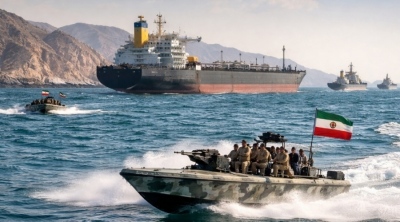
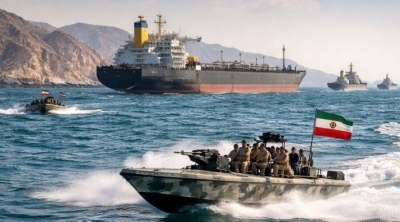
The scene in the Persian Gulf is literally a thriller. Ηowever, the only positive aspect is that the military option is weakening for now. Nevertheless, Trump on the one hand states he is tired of the war, but on the other declares ready to deliver the final blow. While the US and Iran reached a ceasefire agreement, again for the 3rd time until it is obviously violated; President Trump nonetheless threatened Iran that he will "soon deliver the final blow". Paradoxically, Rubio, the US Secretary of State, stressed that the military option is not a priority against Iran. Meanwhile, the NBC report revealing that Iran has caused unprecedented damage to US targets in the Middle East is particularly interesting. The Iranian side, however, acknowledges that the Iran-Oman agreement has been reactivated, confirmed contacts with the US, and announced that Hormuz will act as a two-way highway with a width of 7 miles or 13 kilometers. At the same time, Iran revealed that the temporary Iran-Oman agreement regarding the Strait of Hormuz was also activated.
US and Iran agreed on a ceasefire and free navigation in Hormuz
The US and Iran agreed to a ceasefire, sources in Iran and Pakistan stated. "The agreement includes free navigation in the Strait of Hormuz." An official ceasefire announcement is expected in the coming days. Subsequently, negotiations and a round of technical meetings are scheduled. In mid-June, the parties signed a memorandum that was supposed to launch the process of concluding a peace agreement, but less than a month later, a new round of escalation began. In recent weeks, Iran and the United States, with the help of mediators, have been trying to agree on the terms of a new deal. However, US President Trump announced the launch of an economic operation involving sanctions against the Islamic Republic of Iran. Iran, for its part, emphasizes that the US has failed militarily.
Trump's strange threat against Iran: Soon we will deliver the final blow
US President Trump, repeating threats against Iran, claimed that the United States is attempting to deliver the "final economic blow soon" to Iran by putting pressure on countries trading with Iran. The United States is pressing all nations that still maintain commercial ties with Iran to sever their relations entirely.
NBC shocks: Iran has caused unprecedented damage to US targets in the Middle East causing shock and awe
Iranian strikes have inflicted unprecedented damage on US intelligence and surveillance systems in the Middle East, American television network NBC News reported, citing reliable sources. "Iranian missile and drone attacks have damaged US intelligence positions and surveillance equipment in the Middle East on a scale exceeding any destruction US intelligence services have ever seen in their history." According to NBC, restoration will cost billions of dollars.
Axios: Rubio says US does not plan new attacks on Iran, Trump tired of war
US Secretary of State Rubio informed Washington's allies that the American administration currently has no plans for further strikes against Iran, Axios reported, citing a US official. "Secretary of State Rubio has told several foreign counterparts in recent days that the United States has no plans to launch new attacks on Iran 'for now'," Axios reports. It is also argued that instead of military action, Washington's main efforts will focus on other leverage measures, including sanctions. "It also serves as evidence that the US President has grown tired of this war and wants it to end," Axios states.
Iran and Oman agreed on Hormuz – A 7-mile or 13-km wide maritime corridor will be created
Iran's Deputy Foreign Minister for Legal and International Affairs detailed the temporary agreement between Iran and Oman regarding the Strait of Hormuz, while claiming that reopening Hormuz depends on fulfilling Iranian demands. Kazem Gharibabadi detailed the arrangement he characterized as temporary, pending the establishment of a "permanent route" during further negotiations between the two sides, which are expected to last 30 to 60 days. Iran has set the fulfillment of certain conditions as a prerequisite for opening the waterway, including the cessation of US intervention in regional maritime traffic.
According to Gharibabadi, under the agreement concerning Iran and Oman, the southern route of the Strait of Hormuz will be closed. In the context of MoI violations, the US will attempt to escort illegal vessels through the southern route that runs along Oman's coast. Oman has accepted the closure, the official said, adding that the move will be communicated to the International Maritime Organization (IMO). According to the deal, "vessels entering the Persian Gulf will use Iranian waters, while vessels exiting the Persian Gulf will use Oman's territorial waters," the senior diplomat stated. "Vessels will pass through Iranian waters in both directions," he added. He described the arrangement as operating "like a two-way highway," with a total width of about 7 nautical miles (7 miles x 1.85 km per nautical mile) = approximately 13 kilometers. Gharibabadi stressed that the agreement reached with Oman does not mean the Strait of Hormuz will reopen immediately. He said the issue of the agreement and the issue of reopening the strait were separate matters. The official underscored that the waterway will remain closed if Iran's requirements for its opening are not met. He stated that the requests include the complete lifting of the illegal economic blockade targeting Iran, a permanent end to aggression on all fronts, including Lebanon, and clarification regarding the blockade of Yemen. Gharibabadi emphasized that after the 40-day war, the Strait of Hormuz has become a matter of Iran's national security.
Joey Hood (US diplomat): Neither the US nor Iran is telling the truth about Hormuz
Neither Washington nor Tehran is accurately reflecting the prevailing situation in the Straits of Hormuz, according to former US diplomat Joey Hood. "Donald Trump often says the straits are open and he is not entirely accurate when saying that," Hood told Al Jazeera. "And the Iranian side is not entirely accurate when it says it has closed them." Hood said Iran lacks the physical means to completely block the maritime route. "It is not like a highway where you can pull down a gate and close it or place an obstacle to block navigation," he said. Instead, Iran relies on coercion: "What they do is make threats and then fire missiles at unarmed merchant ships in order to try to impose their will."
Not everyone complies
Hood said not all ships comply. "Some turn off their transponders, move at night, and sail very close to the Omani coast," he said, while the US military attempts "to protect them with whatever means it has," Hood argued, noting that the US can sustain the naval blockade and sanctions against Iran indefinitely. Hood stated that shipping companies appear to accept the risk of transiting the Strait of Hormuz rather than suspending operations. "They cannot hit all our ships, so let's keep sending them and accept the risk that occasionally we will lose one or two," Hood said, describing the calculus made by involved countries and shipping companies. He added that "they are not going to accept the new regional order that Iran is seeking to impose."
Carrier deployments back to normal routine
Hood said aircraft carrier deployments have now returned to their usual rhythm after an extended period of presence in the region. "The United States typically has 10 or 11 aircraft carriers either deployed in various parts of the world or in scheduled maintenance," he said, noting that as a rule they "rotate roughly every six months." As he said, the deployment of the USS Abraham Lincoln was an exception, extended "for several months beyond the usual schedule because Donald Trump started the war in late February." Now that aircraft carriers have returned to their standard rotation cycle, Hood said the broader pressure campaign can be sustained over time. "The naval blockade and economic sanctions are measures the US government can continue to implement for a very long time, at almost no cost to itself or the American people," he said, noting that sanctions "have been in place for more than 40 years" and "over time have become stricter and more comprehensive."
Al-Wefaq (Iranian newspaper): Iran-Oman talks on Hormuz do not mean reopening
Ongoing talks between Iran and Oman regarding the management of the Straits of Hormuz should not be interpreted as a sign that Tehran intends to reopen them, according to Mokhtar Haddad, editor-in-chief of Iranian newspaper Al-Wefaq. "Iran and the Sultanate of Oman have been dealing with this issue for some time. However, this does not mean Iran will open the Straits of Hormuz," Haddad told Al Jazeera. As he said, Tehran has separated the two issues. "Iran has repeatedly stressed that this process is separate from the issue of reopening the Straits," Haddad stated, describing a process that begins with "a temporary agreement, after which a final deal will be announced." He argued that any such agreement would not extend to the reopening of maritime navigation. "Does this mean the Straits of Hormuz will reopen? No, certainly not," he said, adding that "Iranian officials have confirmed this." Haddad stated that Iran's position will remain unchanged "unless the US accepts the Iranian terms contained in the memorandum of understanding," arguing that Washington "must return to implementing the memorandum of understanding" to change the status of the Straits.
US preparing new war after midterms
Haddad also argued that recent American media reports regarding statements by the US Secretary of State about launching no new strikes against Iran reveal a clear strategy: managing the current confrontation until the midterm elections and subsequently resuming broader military action. "He means to say that the midterm elections matter to them. They want to get past this phase and then start fighting," Haddad told Al Jazeera. As he said, Iran is not going to wait until this timeline runs out. "I do not believe Iran will wait while America simply seeks to get past the election period and then return to a broader conflict," he said.
Sanctions remain the same
Haddad dismissed the idea that the announced blockade and sanctions represent anything fundamentally new. "They are the same sanctions," Haddad said, adding that anyone familiar with American policy "can see there was nothing new in this." He said Tehran will respond if Washington does not return to the memorandum of understanding. "If it determines that America has not complied with the terms and has not returned to the memorandum of understanding, Iran will take the necessary measures," he said, pointing as an indication of this stance to "changes in Iran's military mindset and military doctrine during this period."
www.bankingnews.gr



Σχόλια αναγνωστών