

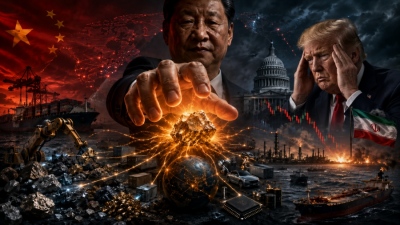
Washington announced it has launched an economic "D-Day" against Iran, although the real battle will not be decided in Tehran, but rather in Beijing. The new American sanctions campaign, dubbed Operation Economic Outcast, aims to strangle what remains of the Islamic Republic's economic lifelines, threatening even third countries that continue trading with it. At the core of this strategy sits an adversary that the US can hardly pressure without paying an extremely heavy price itself: China. Beijing has long been Iran's most important economic pillar, absorbing the vast majority of its oil exports, while simultaneously possessing the means to counter an American escalation - from banking and trade to the powerful card of rare earth elements. It is obvious that the US will not dare provoke a harsh economic confrontation with China, which undoubtedly holds the ultimate weapon to bring the American economy, the dollar, and even Trump himself to their knees.
Who decides the economic D-Day
When US Treasury Secretary Scott Bessent presented "Operation Economic Outcast," threatening new, particularly damaging sanctions against countries refusing to halt their transactions with Iran, he did not name the one country that could determine the operation's success or failure: China. The world's second-largest economy has long served as a vital economic lifeline for Tehran, purchasing the vast majority of its oil exports - estimated to be worth tens of billions of US dollars last year - beyond other commercial transactions. However, persuading China to participate in the White House's latest effort to bend an Iranian leadership that remains stubbornly unyielding after nearly six months of war constitutes an exceptionally difficult undertaking.
Do people in China like Trump?
Beijing categorically rejects what it calls "unilateral" US sanctions and has long defended its right to maintain normal trade relations with partners such as Iran and Russia. It also considers that Washington would hesitate to trigger a broader economic confrontation that would hurt both countries, especially shortly before the US midterm elections. On Tuesday, following Bessent's press conference, China's Ministry of Foreign Affairs pledged to "take all necessary measures" to protect its "legitimate rights and interests" against threats of American sanctions. "Economic war and maximum pressure will not help resolve the issue; all they will do is further intensify tensions and conflicts, create spillover risks, and disrupt the global economic and financial order," declared ministry spokesperson Lin Jian.
No favors
Bessent's threat also arrives ahead of a highly anticipated visit by Chinese leader Xi Jinping to the US next month, during which both sides could make progress toward extending a critical trade truce, set to expire later in the autumn. US President Donald Trump had previously stated that he asked Xi for "no favors" regarding Iran during their meeting in May - a statement that, if accurate, will likely be interpreted by Beijing as a sign of American desperation to end the conflict.
Careful calculation
What remains now is a careful calculation by both countries regarding how they will maneuver during what Bessent characterized as a period of "quiet diplomacy" - meaning, in practice, private formulations of ultimatums toward Iran's economic partners, whom the Treasury chief did not explicitly name during his press conference. Chinese analysts estimate there is limited room for Washington's demands. "China is unlikely to accept a situation in which Washington dictates which third countries Chinese companies can legally transact with," Zhao Long, director of the Institute for International Strategic and Security Studies at the Shanghai Institutes for International Studies, told CNN. "This would set a precedent according to which US secondary sanctions could essentially determine China's trade relations with third countries."
What Washington could do
China imports Iranian oil using an opaque system designed to be insulated from the US dollar system — and from sanctions. Private refineries, the so-called "teapot refineries," buy and process sanctioned Iranian crude, relying on a network of ports, financial institutions, and tankers that are often similarly isolated from international exposure. China has not officially recorded these purchases for years, ever since the US reinstated sanctions on Iran when the first Trump administration withdrew from the Obama-era Iranian nuclear deal. However, according to analysts, points of pressure do exist. "When one examines the ownership structure of these entities at a higher level, it becomes clear that many belong directly or indirectly to major Chinese state-owned enterprises, which are deeply integrated into the US dollar system," said Max Meizlish, senior research analyst at the Foundation for Defense of Democracies think tank in Washington. "By imposing sanctions on their subsidiaries, the US can exert pressure on parent companies to divest; otherwise, they risk being seen as providing direct or indirect support to sanctioned entities," he said.
A look at China's so-called "teapot refineries"
Earlier this year, Bessent stated that Washington had issued warnings to two unnamed Chinese banks regarding their role in transactions linked to Iran. When asked on Monday during his press conference what measures the US would take against non-compliant Chinese banks and shipping companies, he replied that "no one is above" the enforcement of US sanctions. Despite the tough rhetoric, Beijing has previously seen the US threaten broad sanctions — only to subsequently back down. It also knows that Washington is fully aware of the significant economic leverage China holds over the US, particularly through its control over the global supply of strategic rare earths. "If Washington were to cross that line - sanctioning major Chinese banks - Beijing would almost certainly respond, and the political climate for a summit between Trump and Xi would deteriorate sharply," said Sun Chenghao, senior researcher at the Center for International Security and Strategy at Tsinghua University in Beijing. Such a move might not automatically lead to the cancellation of their meeting, but it would "turn the summit from a stabilization effort into a damage limitation exercise," he said.
Calculations ahead of the summit
Both sides will weigh the impact an escalation would have on this summit, which is expected to mark Xi's first state visit to the US in 11 years. While Beijing would not want to appear cooperative with a sanctions regime it opposes, it could make carefully calculated moves - such as quietly reducing oil purchases or reinforcing its political messaging toward Tehran and its efforts to encourage restraint. Chinese purchases of Iranian oil have already dropped sharply compared to last year, as the American blockade has restricted exports of Iranian crude oil.
Convergence over Hormuz
Chinese analysts have also pointed out in recent weeks that points of convergence exist between Washington's and Beijing's interests, particularly regarding the restoration of trade flows through the Strait of Hormuz, which have been severely choked due to the conflict, as well as restoring broader regional stability, which likewise favors trade. Beijing has also reiterated its messages in recent days in favor of restraint and the restoration of normal operations in the region of the straits. In a joint statement issued following a meeting with Jordan's King Abdullah II in Beijing on Monday, Xi called for the restoration of "smooth passage" through the straits and a "comprehensive solution" to the conflict. China's Vice Foreign Minister Miao Deyu stated last week while hosting Iranian officials in Beijing that China is "actively committed to promoting peace talks."
Will not become... Washington's tool
Nevertheless, Beijing has demonstrated caution regarding taking on a direct role as mediator in the conflict, preferring a stance through which it protects its own economic interests — while simultaneously projecting the image of a stable power supporting regional peace, in contrast to Washington's shifting positions. Any cooperation with the US to restore regional peace "should not be reduced to the idea of 'doing Trump a favor,'" Zhao said in Shanghai. "Beijing is willing to contribute to ending the crisis, but it is not prepared to become a tool of Washington's maximum pressure strategy."
Iran as a pariah state
Iran's status as an economic pariah is nothing new. For literally decades, it has been considered a pariah state in the eyes of much of the world. Over the years, the United States has imposed countless sanctions on Iran, targeting its banking system, shipping companies, oil industry, and military. That is why Operation Economic Outcast, the long-anticipated sanctions campaign unveiled this week by American officials, does not carry as powerful an impact as the Treasury Department's rhetoric regarding an "Economic D-Day" might suggest. Many years of harsh sanctions have significantly narrowed the scope for further measures by the United States.
Difficult to understand what Operation Economic Outcast is
"It is difficult to understand what Operation Economic Outcast exactly means, because in essence it is primarily an announcement that future announcements will follow," wrote Justin Wolfers, professor of economics at the University of Michigan, in his Substack newsletter. Iran was already excluded from much of the global financial system. Inflation was already at extremely high levels. Basic necessities have long been in short supply. "There are diminishing returns. This country has been an economic pariah for 50 years and the regime remains in power," said Aya Ibrahim, visiting scholar at Georgetown University's McCourt School of Public Policy and former State Department official in the Biden administration. It is like a referee trying to penalize a hockey player who has already been ejected from the game. Beyond a certain point, punishment ceases to achieve its intended effect and loses its overall effectiveness.
Where they are betting
However, American officials are betting that another turn of the screw - Operation Economic Outcast includes targeting more than 60 entities, threatening sanctions against countries trading with Iran, and closing every branch of Iran's Bank Melli - will be enough to ultimately bring down the regime or, at minimum, lead to the diplomatic progress that the troubled economy so desperately needs.
Crossing a red line
Of course, Washington still possesses a major leverage point: targeting Chinese banks that allegedly facilitate Tehran. However, the Trump administration lacks the political will to go to that length - at least for now. Bessent offered a revealing and unusually candid answer when CNN's Kevin Liptak pointed out that D-Day in 1944 was a real invasion and not merely a threat of invasion, asking why the Treasury Department did not take immediate action. "Why would I want to blow up the global financial system?" Bessent replied. Bessent's response indicates that American officials worry targeting Chinese institutions would amount to crossing a red line. "Secondary sanctions could have a massive impact - but there is a real question regarding political will," stated Ed Mills, Washington policy analyst at Raymond James.
China's monopoly that could change the game
Mills estimates that Operation Economic Outcast will increase pressure on Iran — but only gradually. This could include sanctions against entities in India, Malaysia, or other countries if found to be assisting Iran. "It does not mean this will lack consequences. But the most significant leverage point will likely remain unused," he said. The fear is that Beijing could retaliate by striking a critical US vulnerability: rare earth minerals. China holds a near-monopoly on these minerals, which are essential for manufacturing products ranging from automobiles and jet engines to smartphones, and even the contrast agent used in MRI machines. "Large segments of our economy cannot function without rare earth minerals from China - including automotive, aerospace, and semiconductors," Mills noted. Beijing has already demonstrated a willingness to play this card against Washington. A threatened rare earth shortage last year imperiled supply chains with disruptions similar to those of the Covid pandemic. "We realized very quickly that we cannot afford to have that leverage used against us," Ibrahim stated. A rare earth shortage would represent an economic and political nightmare for the White House - particularly right before the midterm elections.
Sanctions against Iran turn into a fiasco
A recent study, which analyzed nearly two million social media posts by Iranian influencers during previous rounds of sanctions, revealed that these punitive actions do not necessarily weaken support for the Iranian government. On the contrary, researchers found that sanctions occasionally had the opposite effect, causing opposition fragmentation and bolstering support for the regime - even among moderate critics of the government. "You can make a country poorer for decades, but you cannot dictate how its political system will evolve," stated Wolfers, professor at the University of Michigan.
Same tactic for decades
Wolfers stated that the concept of using economic isolation to overthrow a regime is anything but new. It is a tactic Washington has deployed for more than six decades against Cuba. "It is striking how much the current situation resembles a repeat of the same playbook, with only minor adjustments," Wolfers noted.
Boomerang for the dollar
Some also worry that Washington's willingness to weaponize its dominance over the dollar-dominated financial system could ultimately backfire. Washington's heavy reliance on sanctions in recent years - against Russia under the Biden administration and now against Iran under Trump - could encourage countries to seek alternatives to the dollar, undermining the US role in the global banking network operating through SWIFT. "We believe the risk is real," Jaret Seiberg, managing director of TD Cowen's Washington Research Group, wrote in a client note on Monday. "The more broadly the US weaponizes access to the US dollar, the greater the risk that countries and banks will begin seeking alternative payment systems."
www.bankingnews.gr


Σχόλια αναγνωστών