

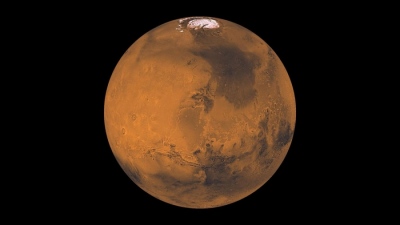
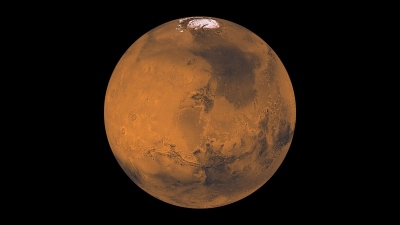
Indications of the existence of ancient microbial life beyond Earth may be hidden inside a small rock with unusual spots, which is already on Mars inside a specialized tube from NASA.
The sample, collected by the rover Perseverance from an area where rivers flowed more than 3 billion years ago, is considered one of the most promising findings in the search for life on the Red Planet.
However, there is a paradox... Specifically, scientists have in their hands a sample that could help answer one of humanity's greatest questions, but they currently lack a clear plan to return it to Earth. NASA's program to transport Martian material was canceled due to high costs and complexity, while China prepares to attempt its own sample-return mission.
The rock with strange spots puzzling scientists
The sample is named Sapphire Canyon and is roughly the size of a piece of chalk. The Perseverance rover collected it in July 2024 from an arrowhead-shaped rock formation known as Cheyava Falls, in the Neretva Vallis area. This is a valley carved by rivers that flowed into an ancient lake inside Jezero Crater more than 3 billion years ago. The area was selected for exploration precisely because water could have created or altered rocks capable of preserving signs of ancient life.
Sapphire Canyon stands out due to the tiny spots covering its surface. Similar formations on Earth, known as reduction spots or reaction fronts, can appear in soils and sediments due to chemical processes linked to microbial activity. When microorganisms break down organic matter inside buried sediments, discolored areas and spots resembling those identified on the Martian rock can form.
«It is the first time I believe we have found something that meets the requirements to be characterized as a potential biosignature on Mars», said Adrian Broz, a member of the Perseverance science team and postdoctoral researcher at Purdue University. As he explained, the sample remains sealed inside the rover, waiting to be transported to Earth.
The significance of the find is reinforced by the fact that the sedimentary rocks surrounding the Cheyava Falls formation were also covered with hundreds of thousands of similar spots. However, the resemblance to formations associated on Earth with microbial activity does not, by itself, prove that life existed on Mars.
China wants to be first to bring rocks from Mars
While the samples of Perseverance remain on the Red Planet, China is preparing its own mission, aiming to return Martian samples to Earth in 2031.
The Tianwen-3 mission is expected to launch in 2028 and entails two separate launches. The first will carry a lander, an ascent vehicle, and a helicopter, while the second will include an orbiter around Mars and the sample-return system.
The design builds upon China's experience from the Chang'e-6 mission, which in 2024 brought to Earth the first samples from the far side of the Moon. The Chinese lander will feature a drill capable of reaching a depth of up to two meters beneath the surface of Mars. In parallel, the helicopter will be able to collect rocks from different locations.
Mission scientists are examining 86 potential landing sites, prioritizing areas where liquid water previously existed, locations rich in minerals, and environments that could have preserved traces of ancient microbial activity.
The goal is to collect two different types of samples: rocks with iron oxides, which may have preserved structures resembling cells, and materials rich in aqueous clays, which could contain ancient organic molecules.
The samples from China may differ significantly from those already gathered by Perseverance, depending on the sites selected and the final evolution of the mission design.
If Tianwen-3 succeeds, China could become the first country to return samples from Mars, despite the fact that NASA has already assembled substantial scientific material on the planet.
This development also takes on a geopolitical dimension, as the United States and China compete for leadership in space exploration.
There is still hope for NASA's samples
Despite the cancellation of the original program, the prospect of returning the samples has not been permanently abandoned.
NASA Administrator Jared Isaacman has stated that he considers the return of Martian samples potentially one of the most important scientific discoveries in human history. He has also left open the possibility that their collection could be carried out either using robotic systems or with the participation of astronauts.
In parallel, private companies are exploring alternative solutions. Lockheed Martin has submitted a fixed-price proposal under 3 billion dollars to return 30 samples to Earth no later than 2037.
The plan relies on a lightweight Mars ascent vehicle, a small lander, and a compact system for transporting samples to Earth. The company maintains that it leverages technologies and experience from prior space missions to curb complexity and costs. It remains, however, unclear whether and when such a solution will be approved.
Perseverance has already filled 33 tubes with rock, dust, and Martian atmospheric samples. Ten of these have been left at a designated depot on the planet's surface so they can be retrieved by a future mission.
www.bankingnews.gr









Σχόλια αναγνωστών